

Lady Di
The Little Girl Who Felt Invisible

There are some souls who leave this world, yet their presence lingers like a soft fragrance long after they are gone. Princess Diana is one of them.

It has been 28 years since she left us — and I am 28 today.
Yet somehow, I feel her.
Not as a distant historical figure,
but as a woman whose pain, gentleness, and courage echo through time with startling clarity.
Maybe it’s because I grew up watching her smile in old videos — a smile bright enough to light a room, yet soft enough to hide storms.
Maybe because, like many sensitive hearts, I’ve known what it means to feel too much too young.
Or maybe it’s simply because kindness never dies — it travels, it lingers, it finds the ones who need it most.
When I read about Diana, I don’t just learn her story.
I feel it.
Her wounds.
Her loneliness.
Her instinct to heal others even when she herself was hurting.
There is something profoundly powerful about a soul who turns pain into compassion.
And that is why this series exists — to honor not just her legacy, but her humanity.
If my words have supported you, I ask — with deep gratitude — for your pledge to help this healing reach further. Your support keeps Wounds & Wisdom alive and able to touch more people who need it.
Today, I step into her early world, imagining her voice, her heart, her little-girl fears… so we can understand how her wounds became her wisdom.
Let’s begin.
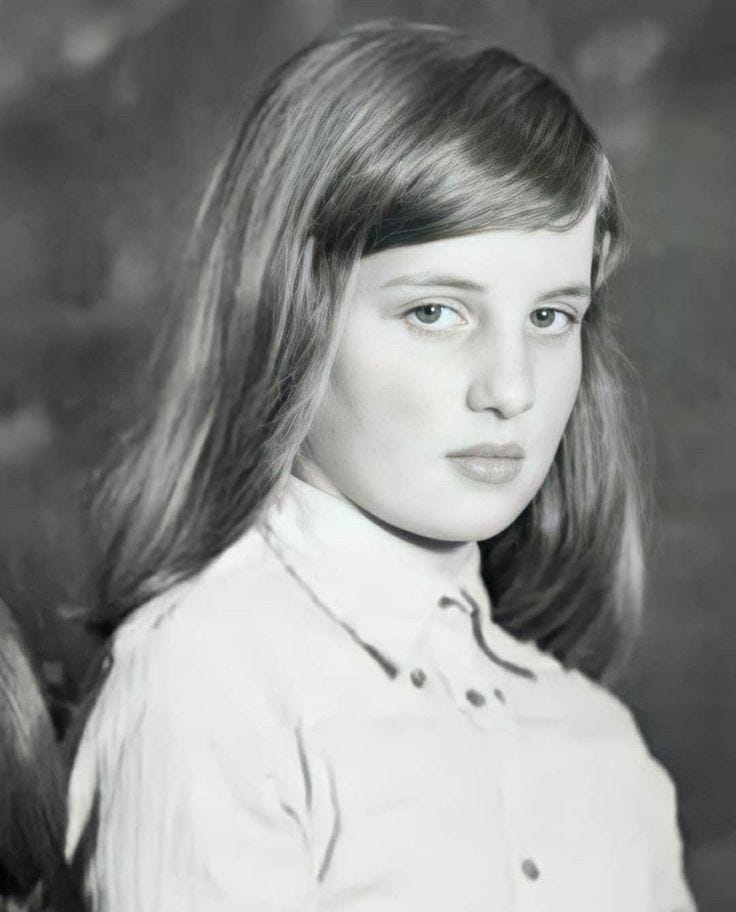
Diana’s Voice
I was born into a world that looked gentle from the outside — a world of polished silver, pressed uniforms, and centuries of family tradition. People often imagine that a childhood surrounded by privilege must be perfect.
But behind the tall windows of Park House, my early life felt much colder than anyone knew.
I came into this world on July 1, 1961 — the third daughter of parents who were quietly hoping for a son. It may sound small, but even as a child I sensed it: a subtle feeling of not being the piece they expected in the family puzzle.
My parents loved us, but their marriage was fraying long before anyone dared to speak it aloud. Children have a way of hearing the truth in silences, and I heard it everywhere — in the pause before a reply, in the footsteps that avoided each other in the hallway.
Some of my earliest memories are not of laughter, but of raised voices behind closed doors. The sound traveled through the endless corridors, and I’d sit with my knees pulled to my chest, trying to understand why love in our home felt so fragile.
And then, when I was eight, my mother left.
She didn’t take me with her.
Although she came back into my life later, the moment she walked away lit a quiet ache inside me — a truth I’d carry for years:
Love can leave, even when you need it most.
People often wondered why I grew up to care so intensely for strangers — why I hugged people society turned away from, why I held hands everyone else avoided.
The truth is simple:
When you’ve known the sting of emotional abandonment, you vow that no one else should feel it if you can help it.
At school, I wasn’t the brightest in the traditional sense. But I carried something else — a heightened awareness.
I could feel people.
Their loneliness.
Their attempts to appear strong.
Their longing to be seen.
I recognized sadness across a room because I had lived with it myself.
I wasn’t born compassionate.
My compassion was born from my wounds.
As I grew older, I gravitated toward jobs people didn’t expect from a Lady: nanny, cleaner, part-time kindergarten assistant.
Not glamorous roles — but meaningful ones.
I wiped tiny noses, tied shoelaces, read bedtime stories with tired eyes. I comforted trembling hands and held little faces close until their tears softened. Those were the moments that felt real to me.
Maybe because somewhere inside, I was still trying to comfort the little girl I once was.
Those simple jobs taught me more wisdom than any aristocratic rule ever could — the beauty of tenderness, the courage in gentleness, the quiet power of simply showing up.
My early wounds didn’t harden me.
They softened me.
They made me gentle in a world that wasn’t.
They taught me to love loudly because silence had hurt me too deeply.
Standing at the edge of adulthood, I could feel life shifting — preparing to pull me into a world I had never imagined. A world that would magnify both my insecurities and my gifts.
I didn’t know it then, but my story was about to change forever.
My childhood taught me this:
When love isn’t given, you learn to give it.
When affection is withheld, you learn to offer it freely.
When you are unseen, you learn to make others feel visible.
And the world I was about to enter…
would test that softness in unimaginable ways.
But that part of the story lies ahead.
Conclusion —
What I take from baby girl Diana — the child behind the icon — is a truth we often forget:
The gentlest hearts are shaped by the heaviest shadows.
Diana wasn’t kind because life was kind to her.
She was kind because life wasn’t.
Her empathy was born from loneliness.
Her compassion was born from pain.
Her courage was born from not wanting others to feel what she once felt.
As a 28-year-old woman today, I look at her story and think:
If she, with all her wounds, could still choose love — then so can we.
If she could transform hurt into healing, maybe we can too.
This is why her presence feels alive even 28 years later.
Not because she wore a crown.
But because she carried a heart the world couldn’t forget.
And this is only the beginning.
Episode 2 is coming soon…
where the quiet girl steps into a destiny she never asked for.
One of the purest soul Queen Diana 👸 ,thank you for bringing this great story Nivedita.s